Juliia, Dialog and iAdvize all promise AI-powered e-commerce support, but they solve different problems. Compare features, pricing and fit for 2026.




Juliia vs Dialog vs iAdvize: which e-commerce AI agent should you choose in 2026?
Type "e-commerce AI agent" into a search engine and you'll land on a dozen solutions that are readily presented to you as interchangeable. They are not.
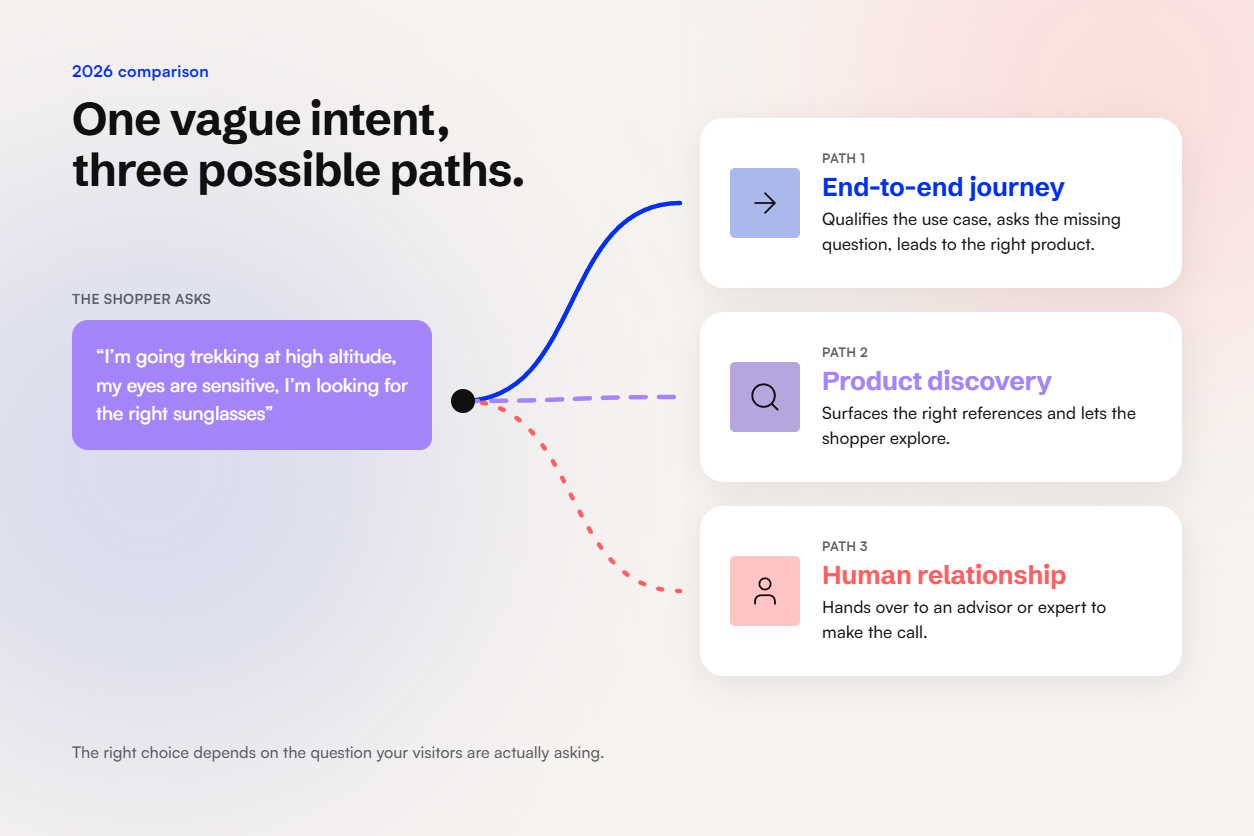
Juliia, Dialog and iAdvize all use artificial intelligence to support e-commerce website visitors and facilitate the sale. But the way they do it, and above all where in the journey they intervene, differs significantly.
Dialog places strong emphasis on advice and product discovery. iAdvize historically comes from conversational commerce and today combines AI with human intervention. Juliia starts from the needs of e-commerce teams and supports the visitor directly throughout their purchase journey, from discovery through to the cart.
Comparing these three solutions is therefore less about looking for the best AI agent in absolute terms than about determining which one matches the conversion problem your site is trying to solve.
In short: what distinguishes these 3 e-commerce AI assistants?
Juliia is particularly suited to e-commerce businesses that want to support the entire purchase journey on large catalogs, with complex content requiring human-level advice to improve conversion: discovery, advice, recommendation, comparison, upsell and cross-sell, all while letting business teams directly steer the experience based on their business priorities.
Dialog suits brands seeking above all to strengthen product discovery and recommendation through an AI shopping assistant, and is exclusively dedicated to the Shopify ecosystem with fully automated onboarding.
iAdvize, historically a chatbot specialist, stands out through its hybrid approach, combining artificial intelligence, conversational commerce and human intervention. The solution is particularly relevant for organizations that already have a large, structured customer relationship team.
The choice therefore depends less on the technology than on where your site is currently losing customers, revenue or average order value.
What is an e-commerce AI agent?
An e-commerce AI agent is an intelligent assistant integrated into an online store that supports visitors throughout their purchase journey.
Unlike a classic chatbot, mainly designed to answer questions, a commerce-oriented AI agent must be able to understand purchase intent, explore a catalog, recommend products, compare references, respond to objections and, depending on the solution, act directly on the journey: facilitate navigation, adopt the right tone, suggest complementary products, ease the add-to-cart process.
The goal is therefore not just to automate customer support. It is about reproducing online part of the role of a good in-store salesperson: understanding what the customer is looking for, helping them choose and reducing the friction that prevents them from buying.
It is precisely on how to accomplish this mission that Juliia, Dialog and iAdvize differentiate themselves.
Comparison of the best e-commerce AI agents in 2026
Pricing and features observed in 2026 and subject to change. It is recommended to verify offers directly with each provider.
Dialog: an AI assistant centered on advice and product discovery
Dialog has built its approach around a simple idea: turning product discovery into conversation.
When a visitor hesitates between several references, is looking for a product matching a specific need, or needs reassurance before buying, the assistant can help them navigate the catalog, compare options and formulate a recommendation.
This logic is particularly interesting for catalogs where the choice itself constitutes a friction point: beauty, fashion, equipment, electronics or products requiring a certain level of explanation.
Dialog integrates natively with Shopify but also offers integrations with other e-commerce environments. The solution also goes beyond a simple product-page FAQ, with discovery, recommendation and re-engagement features.
Its model nevertheless remains strongly centered on AI-assisted shopping. For a brand whose main problem is helping the visitor understand the offer and choose the right reference, this specialization can be an advantage.
On the budget side, pricing starts around $249/month and evolves notably according to usage level and the plan chosen. For stores experiencing strong traffic growth, it is therefore necessary to look not only at the starting price, but also at how the bill will evolve with the audience.
iAdvize: combining AI shopping assistant and customer relations
iAdvize comes from another world: that of live chat and e-commerce bots.
Created well before the arrival of generative AI, the platform has historically allowed brands to connect their visitors with real advisors. It now incorporates AI agents capable of handling part of the conversations, while retaining the ability to transfer certain interactions to humans.
This heritage is reflected in the product.
The challenge is not only to recommend a product: it is about orchestrating the customer conversation between automation and human expertise, across different touchpoints.
This approach is consistent for an organization that already has a structured customer relationship team and wants to augment it with AI rather than replace it. It can also make sense when sales are long and regularly require an advisor's intervention.
The flip side is that of a broader platform: deploying and orchestrating AI/human can require more configuration than a shopping assistant installed on a specific scope.
On pricing, iAdvize offers start around €290/month, with AI conversation caps that vary by plan. Higher-tier offers then increase the available volume and features, while certain customer service building blocks are offered separately.
For a company seeking above all to build an omnichannel customer relations architecture blending AI and humans, this depth can be an advantage. For a team looking only to quickly improve its purchase journey, it can also represent an unnecessary level of complexity.
Juliia: an AI agent that supports the entire e-commerce journey
Juliia starts from a different place.
Rather than building the experience around a particular page or contact channel, Juliia is an e-commerce AI agent designed to support the visitor throughout their entire purchase journey, from engagement through to the sale. The solution's stance is to offer an experience similar to the one received in-store or with an expert phone advisor.
The visitor can express their need naturally:
« I'm looking for a dress for a wedding in September, under €150, that I can wear again afterward. »
The agent doesn't just respond in a chat window. It can act directly within the store's interface: update results, trigger filters, direct toward relevant products and facilitate adding to cart.
The idea is to bring the digital experience closer to that of a good in-store salesperson: understanding intent before seeking to sell a product.
The difference also plays out in the control left to e-commerce teams.
Sales scripts, product priorities, margins, recommendations, business rules, cross-sell, upsell or brand tone can be managed from a dedicated interface. The goal is to avoid a change in commercial strategy systematically requiring a ticket to a technical team.
Juliia is also CMS-agnostic: the agent integrates into the store's front end without imposing a site redesign or a particular e-commerce platform.
On the budget side, Juliia starts at €290/month, with a subscription model in which features are included rather than split into a succession of options, and with no limit on the number of conversations.
This positioning is therefore aimed particularly at e-commerce teams not just looking for a chatbot or an enhanced FAQ, but an AI agent capable of intervening directly in the conversion journey with immediately measurable ROI.
Juliia vs Dialog vs iAdvize: which e-commerce AI agent should you choose?
The three solutions ultimately address three different problems.
Choosing Juliia to support the entire purchase journey
Juliia is particularly relevant when the friction points are not located on a single page.
A visitor may struggle to articulate their need, navigate a large catalog, choose between several products, understand their differences or identify the relevant complementary products.
In this context, the value of a full-funnel agent is to maintain the same support from the first "I'm looking for…" all the way to the cart.
Juliia is also suited to organizations that want to let their e-commerce teams steer the commercial logic themselves without depending daily on a technical team.
Choosing Dialog to strengthen advice and product discovery
Dialog is particularly interesting when the main friction is centered around product choice.
For a store with many similar references or products that require advice, an assistant specialized in discovery and recommendation may be enough to significantly improve the experience.
The solution can therefore be particularly relevant for brands wanting to quickly deploy a layer of AI-assisted shopping within their e-commerce environment.
Choosing iAdvize to combine AI and human relations
iAdvize addresses a different need: keeping the human in the loop.
When some conversations can be automated but others require an advisor's intervention — complex sale, high cart value, specific request or customer service — its hybrid architecture makes complete sense.
The solution is therefore particularly suited to companies that already have a customer relations organization and are looking to enrich it with AI agents.
How much does an e-commerce AI agent cost?
The price of an e-commerce AI agent depends less on the technology used than on its economic model.
Some solutions charge based on traffic or number of visitors. Others limit the number of AI conversations included in each plan. Others still operate mainly as a subscription.
It is therefore important to avoid comparing only entry-level prices.
To assess a solution's real cost, an e-commerce team should notably look at:
- the volume of traffic or conversations included;
- the cost as the site grows;
- the features included in the subscription;
- any paid add-on options;
- the resources required for deployment and configuration;
- the level of autonomy left to business teams.
An agent shown as cheaper at the outset can thus become more costly as traffic grows, while a more comprehensive platform can be oversized relative to the problem actually encountered.
The right indicator therefore remains return on investment: how much does the solution cost relative to the conversions, average order value or additional revenue it enables you to generate?
So, what is the best e-commerce AI agent in 2026?
There is no best e-commerce AI agent in absolute terms.
There is, above all, an agent better suited to each friction point.
If your main problem is helping visitors choose between several references and better understand your products, Dialog deserves consideration.
If the challenge is automating part of the customer relationship while retaining the ability to bring in human advisors, iAdvize has a particularly well-suited architecture.
If you are looking to support the visitor throughout their entire purchase journey, act directly on the browsing experience and reduce your customer advisory costs while letting e-commerce teams steer the sales logic themselves, Juliia answers this need more closely.
Before choosing an AI agent, the best question is therefore perhaps not:
« Which solution has the most features? »
But rather:
« At exactly which point in my purchase journey am I currently losing customers? »
It is from this answer that the choice becomes much simpler.
Keep exploring
Dive into more articles to explore the future of conversational commerce and AI for conversion.
Juliia vs Dialog vs iAdvize: which e-commerce AI agent should you choose in 2026?

Key questions on ai ecommerce assistants and choice of alternative
Top 6 questions about ai ecommerce assistants and alternatives to Juliia
