Objection 1/7: “We already have one, and it does the job.” An AI agent that works is not necessarily an agent that sells.




This series looks at the 7 good reasons a Head of eCommerce might have for not exploring (or re-exploring) a conversational AI agent for their site. The first objection, and probably the most common: "We already have one, and it does the job." The stance is simple: an agent that works and an agent that creates value are not the same thing.
Strong demand, agents still falling short
The demand is clearly there. According to the AI eCommerce Agents Barometer published by Fevad in July 2026, the French eCommerce federation, 65% of consumers would already like to use an AI-powered chatbot to help them shop. And 97% of eCommerce executives see generative AI as the most promising innovation of the coming decades.
But the same barometer, which audited more than 170 French sites and analysed 38 AI agents, reaches a blunt conclusion: most deployed assistants still underperform. Having an agent is a first step. It is not the finish line.
Yesterday's novelty is today's standard
Things move extremely fast in this space. On the technical front first: AI is progressing faster than any technological revolution we have known. But the real shift is on the customer side. In customer experience, what is new one day becomes a plain expectation the next.
French consumers have already made the move. According to the Odoxa study for Fevad presented in February 2026:
- 31% of online shoppers use generative AI when buying online, and 54% of them use it more and more;
- 25% of French people use AI frequently, up from 6% in May 2023;
- 58% of users turn to it before purchase, when they compare and hesitate.
These customers arrive on your site with new habits. They are used to asking a question in natural language and getting an answer tailored to their situation. In the United States, Adobe Analytics found that visitors coming from a generative AI assistant converted 31% better than other traffic sources during the 2025 holiday season. That traffic grew 693% year on year.
So the question is no longer whether your customers are ready for AI. It is whether your agent lives up to what they now expect from it.
Working is not creating value: three questions to ask your agent
A conversational agent can work perfectly well and yet create little or no incremental, measurable business value. That is the "it works" trap. Three simple questions are enough to get out of it.
- Does it remove hesitation? Hesitation is the silent enemy of conversion. The Baymard Institute puts the average cart abandonment rate at 70.22%, based on 50 studies. Behind that number are unanswered questions: which size should I pick, will this product suit my needs, can I return it?
- Does it increase confidence? Again according to Baymard, 19% of shoppers abandon because they don't trust the site, and 13% because the returns policy doesn't satisfy them. Trust isn't declared in a FAQ. It is built through conversation.
- Does it influence conversion and retention? This is the question that matters. If you can't answer it with numbers, your agent is a cost, not a lever. Incremental measurement is covered in another part of this series, on the budget objection.
If the answer to any of these three questions is "I don't know", your agent may well be doing the job. But which job?
A better FAQ is not a sales advisor
What do most agents in place today actually do? They answer product questions, make basic recommendations and provide general information: delivery times, return conditions, size availability. That's useful. But it is a better FAQ, not an act of selling.
What they lack is the ability to understand the customer's context, guide them to the right choice and reassure them about that choice. Yet that is exactly what customers expect. According to McKinsey, 71% of consumers expect personalised interactions, and 76% get frustrated when this doesn't happen. The firm estimates that personalisation can lift revenues by 5 to 15%.
Treating AI for eCommerce as a mere technological feature is rather like feeding jam to the pigs, as an old French saying goes. You have a tool that can converse, understand and advise, and you confine it to reciting product sheets.
Back to the store: what actually makes people buy?
Let's step out of digital for a moment and go back to the physical world.
What makes a store successful? The latest till technology, or the right approach to customer advice? Does a junior who passively answers basic questions sell as much as an experienced sales advisor who has the know-how? Asking the question is answering it.
And why do customers still shop in store when they can buy everything online? The Shopper Trends 2026 barometer by Imediacenter by Valiuz, Epsilon France and Publicis Media offers some answers for the French market:
- physical stores remain French shoppers' preferred channel in every sector studied;
- 78% want to see and touch the product;
- 44% value expert advice from sales staff, rising to 54% among those over 65;
- in specialist retail, 88% of journeys start with online research before purchase, yet almost all of them end in store.
The answer is simple. Successful sales come from a contextualised understanding of needs, and from human reassurance that those needs will be met. Customers don't come for information. They come for confirmation that they are making the right choice.
AI, your newest sales recruit
This is where AI needs to be positioned: as the latest recruit in your sales team. Not as a customer service tool, nor as one more widget on the product page. Its mission is to genuinely digitise the "Art of Selling": listen, understand the need, advise, reassure and close.
This shift in perspective also changes how you assess your current agent. You don't judge a sales advisor on how fast they answer, but on what they sell and the loyalty they build. Here is a simple grid to take stock.
In conclusion
"We already have one, and it does the job" is a legitimate objection. It shows you have taken the first step, which many have not yet done. But the real question is not whether you have an AI agent. It is what it brings you.
Your agent answers. The question is whether it sells.
The next article in this series tackles the following objection: "We don't need one, our site already performs to its maximum potential."
Keep exploring
Dive into more articles to explore the future of conversational commerce and AI for conversion.
Your AI agent answers. But does it sell?
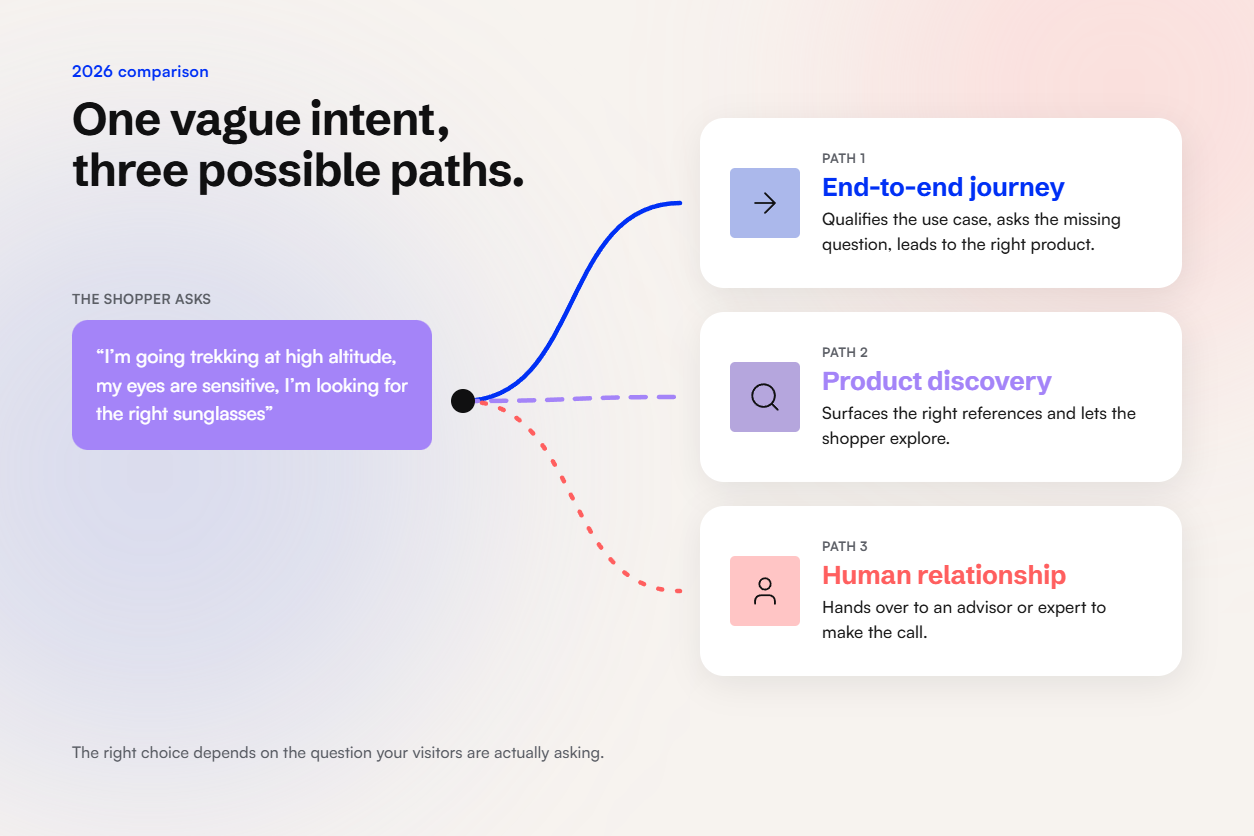
Juliia vs Dialog vs iAdvize: which e-commerce AI agent should you choose in 2026?
Juliia, Dialog and iAdvize all promise AI-powered e-commerce support, but they solve different problems. Compare features, pricing and fit for 2026.
